Friday, January 8, 2010

Vintage, Thrifted, and Handmade: All In One!

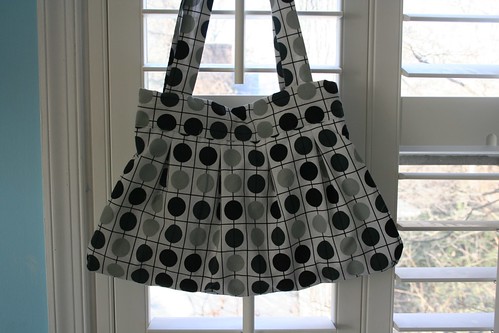
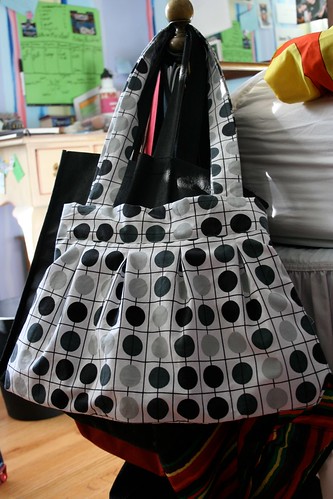
Vintage pleated handbag

It is truly a miraculous thing when your children surpass you in their abilities. It happens for each child at a different age, but all of a sudden you realize -- wow, they can do that better than me! It's one of those parenting moments that knocks you on your metaphorical keister, and then you get back up, brush yourself off, and realize that this is exactly as it should be.

In any case, my sixteen-year-old daughter has long since surpassed me in a number of arenas. She's taking AB/BC Calculus this year and adores it (I like math plenty, but Calculus never clicked for me). She plays piano beautifully, sight-reading with ease, while I can hardly tap out Mary Had a Little Lamb. And (much to my delight and envy), she sews.

Vintage pleated handbag, view 2

Yesterday, she finished this lovely purse, and agreed to let me photograph it, since I am just bursting with pride at her accomplishment. First of all, she got the free vintage pattern off the internet here over at Sewtakeahike (sooo much sewing and crafty inspiration over there!). Second of all, she got the "fabric" at the local thrift store for practically free (apparently it used to be curtains). And then third of all, she sewed this little beauty herself -- in our newly tidied-up sewing area. Thus, vintage, thrifted, and handmade!

Vintage pleated handbag, view 3

Isn't she talented? I hope she teaches me a thing or two before she goes running off to college...

Thursday, January 7, 2010

My Top 10 Most Dog-Eared Cookbooks

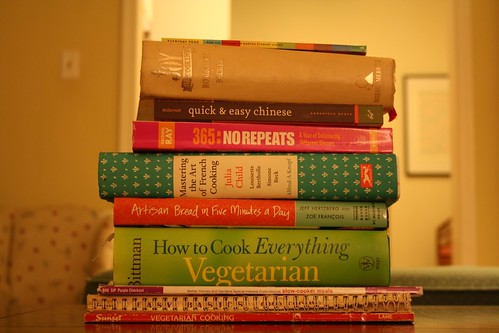
Top 10 Cookbooks

People often ask me what I think the best cookbooks are, but what I always want to know is, what cookbooks do you actually use. What are your daily, dog-eared, soup-splattered go-to cookbooks? (Please share your own tried-and-true sources of recipes in the comments!)

Now I realize that it's 2010 and all, and most of us are getting a lot of our recipes from the internet. I'll cover my own favorite online recipe sources in another post, but for now I'm going to focus on those old-fashioned tomes of culinary knowledge: cookbooks. Like many people who love to cook, I have a weakness for cookbooks. Especially ones with glossy pages and beautiful photographs, ones that make me dream a little about the cook I could become. Of all the cookbooks that have caught my fancy over the years, these are the ones that get used and abused in my kitchen. (I have included Amazon links to the closest thing available for sale today -- a few of these are ancient!)

How to Cook Everything Vegetarian: Simple Meatless Recipes for Great Food
This is one of those fabulous books that gives you the basics of a particular ingredient or recipe, and then offers lots of options for variation. I have learned so much about cooking from this book. Just today, I was eyeing the acorn squash on my counter and wondering, "what am I going to do with you?" How to Cook Everything Vegetarian was the first place I looked for an answer (the verdict: braised acorn squash with rosemary). This is definitely not just a book for vegetarians -- all of us omnivores could benefit from adding more vegetable-oriented meals to our repertoires.

Vegetarian Cooking
A book I bought in high school, when I was one of those vegetarians who survives solely on mac-and-cheese, pizza, and spaghetti. I was trying to listen to my mother and "branch out." At the time, it did not make me a bulgur pilaf convert, but it is now quite well-used, and is the source of the zucchini frittata recipe that is a crowd-pleasing family favorite.

Mastering the Art of French Cooking (Volume 1)
Okay, I did just get this book for my birthday last month, so officially I can't declare myself past the infatuation stage. That said, I really do think this is The Real Thing. Julia Child is so beautifully thorough in her instruction, and my love for French food is so great. I have actually only made three recipes from this so far (all fantastic, especially the soufflé!), but I have read quite a bit of it and it's already dog-eared. I can just tell there are many more glorious meals to come from this one!

Artisan Bread in Five Minutes a Day: The Discovery That Revolutionizes Home Baking
This is my indispensable bread-baking companion. I've already written about my process for baking our daily bread here, but I can't stress enough how important this little book has been to my life in the kitchen. I make new dough about once a week, and bake bread just about every other day, sometimes more. I have made dozens and dozens of loaves of bread from this book, and virtually all of them have been wonderful.

Joy of Cooking: 75th Anniversary Edition - 2006
This is where I look for the basic, generic recipe for just about anything -- which I then might adapt somewhat. How long to cook a pot roast? What's the basic meatloaf recipe? Sugar cookie dough? This is the first place I turn for those sorts of things. I have two copies, one slightly more up-to-date, but my favorite is my grandmother's -- complete with her own dog-ears, notes in the margin, and newsprint recipes tucked into its pages. A treasure. Oh, and the recipe for apple spice cake is out of this world.

Quick & Easy Chinese: 70 Everyday Recipes
One of those gorgeous cookbooks that drew me in with its photographs, and the promise of... easy?? Chinese??? Yes, please! It delivers. The sauces are truly easy and authentic-tasting (to my untrained palette, at least), the recipes (so far) fool-proof. The scallion pancakes in particular are extremely popular around here.

Rachael Ray 365: No Repeats--A Year of Deliciously Different Dinners (A 30-Minute Meal Cookbook)
I have to credit Rachael Ray with easing my transition from the kind of cook I was 6 or 7 years ago (as in, the kind that can read the instructions on the box) to truly starting to cook from scratch. The "orzo with the works" recipe from this book is a regular on our table, and her recipes for fresh salad dressings are what caused me to stop buying the bottled stuff altogether. Also, her heavy use of fresh herbs was certainly one of the factors in my starting to grow my own (and oh how my modest ambitions for a few pots of herbs on the deck have grown!).

Easy Basics for Good Cooking
Another high school purchase, probably my most butter-smeared cookbook. The sad thing is, I haven't actually made all that many recipes from this book, but the ones I have made have been repeated so many times, I'm surprised I still have to consult the recipes at all. My banana bread, my basic muffins, my crepes (ah, now you see why it's so butter-smeared).

Everyday Food
I hesitate to post this, because it's not technically a cookbook. It's a magazine. But I have this one issue that I think I have made every recipe in. These are simple, no fuss recipes out of great basic ingredients, often combined in novel ways. This is a really great magazine especially for those cooking for busy families -- they are fast, and often there's a shopping list combining multiple recipes. I owe the publishers my undying gratitude for bringing the asparagus-gruyere tart into our lives. YUM.

Slow-Cooker Meals, 2008 Issue
Another magazine, and it's one of those Special Interest Publications, so not reliably available. But keep an eye out in your grocery aisle -- this one's a keeper! I have several slow-cooker cookbooks, but this little magazine gets the lion's share of my attention. The recipe for three-bean vegetarian chili alone is worth the $9.95 I paid for it. (Secret ingredient: chocolate sauce!)

I'd love to hear what your go-to cookbooks are. I'm always on the lookout for something new to smear, splatter, and love.
Wednesday, January 6, 2010

January in the Garden

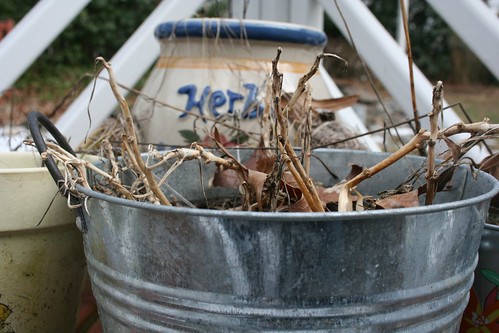
Herbs

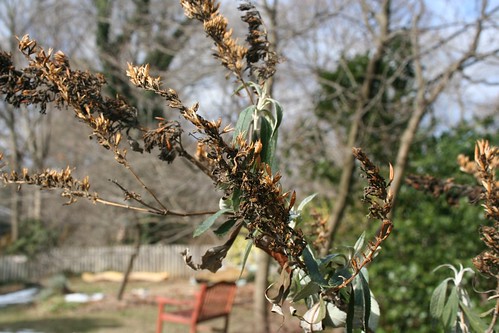
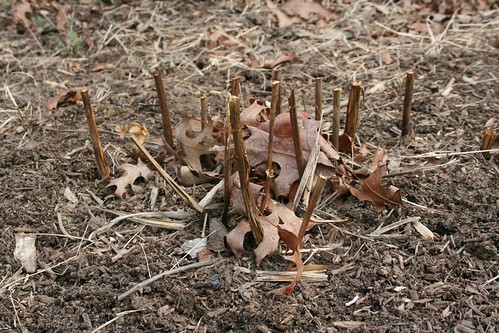
Generally, my garden gets completely ignored during the winter months. And today, I realized what a crying shame that is. True, it does look kind of dead, but like me, it's just waiting. All that pent-up life, just resting, rejuvenating, anticipating. As I walked through the garden, I saw memories of the seasons just past, and signs of the spring and summer to come.

Butterfly bush

Here is where the peonies will rise again

Rhododendron, waiting

And then I took a few moments to admire the garden just exactly as it is right now. Not for its potential, but for all of its beauty right here on a bright and cold January day.

Frozen pond

Welcome to my garden sign

Stone wall

Bare oak and sky

Tuesday, January 5, 2010

A Playful Start to the Day

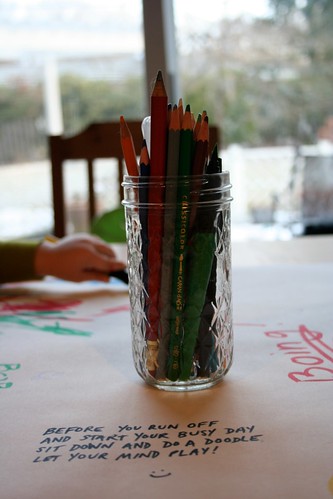
Last night, before going to sleep, I tiptoed downstairs and set the kitchen table up with a huge piece of paper and a jar of colored pencils and markers. When the family straggled down in the morning, they found this:

IMG_3037

Now, I will readily admit that I did not come up with this idea. I remembered Amanda over at SouleMama doing something similar, and I thought -- wow, what an inspired idea.

IMG_3039

I am notoriously slow to wake up. Oh, sure, I might be downstairs, upright, drinking coffee, but I am not really and truly awake. And I thought this might be a great diversion to keep the kiddos engaged while I'm still going through re-entry. What I did not anticipate, however, is how much fun I would have, starting the day with a little silly creativity.

IMG_3043 copy

Oh and yeah, the kids liked it too. In fact, I have been instructed that this needs to be the new morning routine: "we start with art!" I can think of a lot worse ways to begin the day.

Sunday, January 3, 2010

Serious, Precise, No-Kidding-Around Cooking

Sometimes I like to cook by the seat of my pants, wantonly throwing ingredients in a pot, with a devil-may-care flip of the wrist.

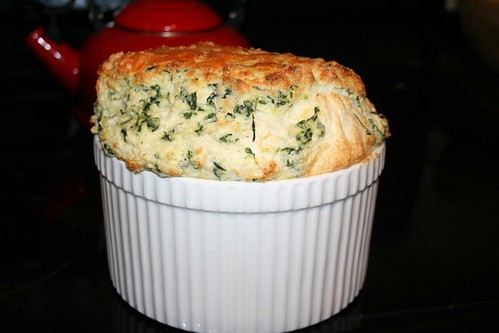
And sometimes, that would be a very, very bad idea. Like when you want to make a soufflé.

Magnificence!

I don't know why I got it in my head to want to make a soufflé. Maybe it just appealed to me as a recipe that inspires culinary fear. All I really knew about a soufflé was that there were a lot of ways to screw one up. I received a copy of Julia Child's Mastering the Art of French Cooking, Vol. 1as a birthday gift, so I read the section on soufflés. Really, it was a six-page essay, complete with a thorough discussion of the many potential pitfalls, followed by one of the most detailed "recipes" I have ever read. Precision, precision, precision. I took it as a challenge.
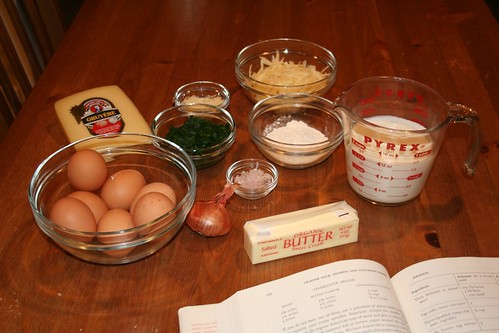
You can use the following steps to tackle any major cooking challenge. Regardless of what you are making, the general approach is the same. These sorts of adventures are not for the faint of heart, but they are almost always well worth the effort, and leave you feeling like a kitchen rockstar.

Step #1: Assemble all necessary equipment. In my case, this boiled down to acquiring a soufflé dish -- easily accomplished with a trip to Crate & Barrel. $9.95 later, I own a 2-quart soufflé dish (which is essentially a straight-sided bowl, thus can be used for lots of things and not a dreaded unitasker).

Step #2: Read the recipe. Again. And again. Check and double-check proportions (Julia helpfully gives proportions of ingredients for both a 6-cup and an 8-cup dish). Know the recipe intimately. I really can't stress this step enough, when making something intricate like this. There is no time to clarify your understanding of the process when it is already underway. You can't start blithely beating the eggs before double-checking and discovering you were supposed to separate them first. You really do have to take the time to understand what the recipe is asking you to do, which things will have to be happening simultaneously, etc. This is time well-spent and will save you heartache and frustration later on.

Souffle ingredients

Step #3: Measure out all ingredients before turning on an oven, heating up a pan, anything. Once you have a hot pan demanding your attention, you are off and running. Don't let any outside influences dictate your speed. Take your time, measure everything carefully, and don't really begin until you are prepared. I have a gazillion glass bowls of different sizes that come in very handy with this step. Again, pay attention to things in the recipe like "room temperature eggs."

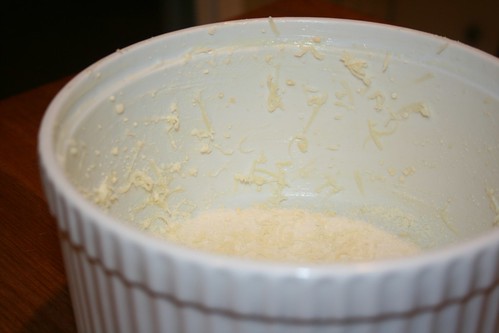
Souffle dish prepared

Step #4: Pre-cooking. Many complicated recipes call for ingredients that may take some preparation. This includes everything from chopping vegetables, to melting butter (for all those recipes that call for "melted and cooled" butter), to steaming the spinach and squeezing all the water out before chopping and sautéing with shallots. Anything that can be done and then can wait indefinately for the next stage of the recipe should be done now.

Step #5: Study that recipe again. Assemble every piece of equipment right where you're going to need it. Place each pan on the burner where you're going to use it, and go ahead and pre-heat the oven. Plan out the precise timing of simultaneous and sequential actions. For instance, my soufflé recipe called for the making of a roux, which is then taken off the heat and to which boiling milk is added. So, how long does it take to bring milk to a boil? And how long will it take to melt the butter, add flour, and cook for two minutes? What order are you going to turn on the burners, and to what heat? Figure it out now, you will not have time to wing it later. (In my case, I overestimated the time it would take to boil milk, had to turn down the heat and then bring it back to a boil. Lesson learned for next time.)

Step #6: Go! Hopefully all the pre-measuring and pre-planning will allow to you focus completely on the task at hand, and this kind of cooking will require focus. You've got to pay attention to details like "bubbling" and "stiff peaks" and "not yet browned." This part is the most stressful for me -- woe betide the family member who innocently strolls into the kitchen at this stage. It is also, frankly, exhilarating. This is the buzz, the juice, the adrenaline rush... because here is all the risk, here is where you will either succeed for fail. Scary fun!

This is also where you are most likely to screw up. As everything was perfectly timed and I was grooving right along and maybe getting just a little cocky... I dropped a speck of egg yolk in the whites. Like an idiot, I was separating the eggs right over the bowl that already contained all the carefully separated whites. Now, because I had already read and re-read Julia's essay on soufflés, I knew this was a disaster. A mere drop of egg yolk in the whites can cause them to fail, at which point the entire thing would be a loss. I tried to scoop out the yolk, but I just made it worse. So I took my six carefully-separated eggs, dumped them in a container (they were used for omelets in the morning), and started over with the separating (thankfully I had enough eggs on hand). This time, I took my infinitely wise husband's advice and separated each egg over a small bowl before adding to the collection of yolks and whites -- that way if I messed up again, only one egg would be lost. Damage control. Anyhow, the great egg mishap set me back a full ten minutes in my timing -- things were cooling that were supposed to be hot, I was getting just a wee bit nervous... but it was still worth it to take the time to get it right.

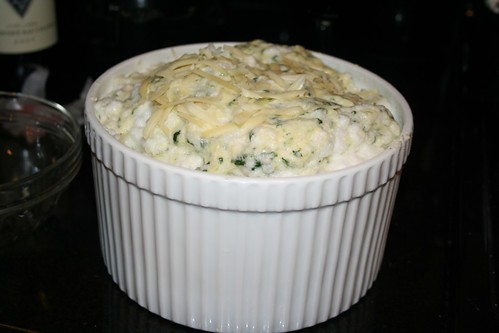
Ready to bake

Step #7: Cross your fingers. For me, this was while the soufflé was in the oven. Will it puff up and brown? Will it collapse? Did I fold in the egg whites enough? Did I overfold?? Agony.

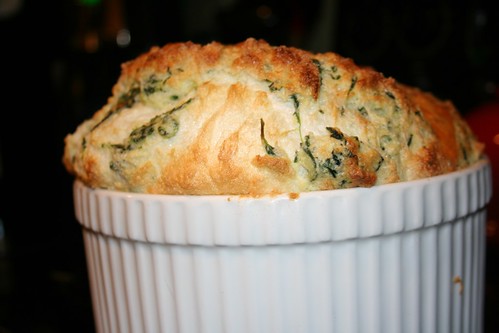
"Puffed and browned"

Step #8: Revel in your success, and/or learn from your mistakes. And take notes! A good cook's cookbook will have lots of notes in the margin -- do not trust yourself to remember these things. If you ever decide to take this particular culinary adventure again, you will have the benefit of your own experience to guide you. Priceless! Hands-on experience is the best teacher, bar none.

Friday, January 1, 2010

Cooking With Abandon

IMG_3004

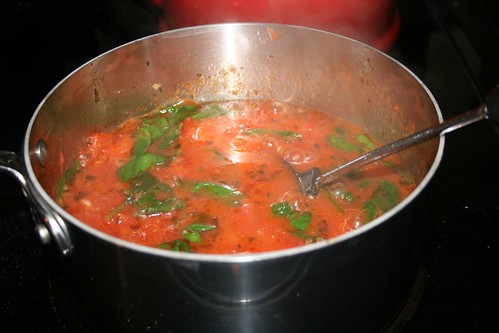
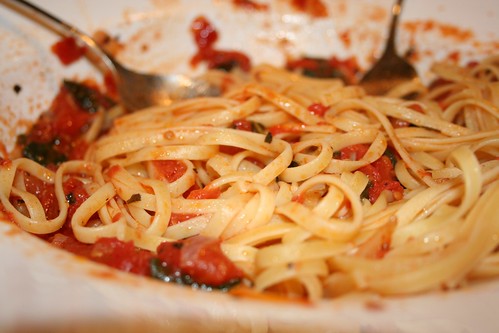
The most important thing I have gained in the kitchen after years of increasingly serious cooking is the confidence to improvise. The other night I was making an incredibly simple tomato-and-basil pasta sauce, one I've made dozens and dozens of times before. I opened the fridge to get the garlic, and saw some shallots and spinach, and I thought... hmm, that sounds good. So I took the tomato-and-basil theme, and riffed on it with shallots and spinach. The result was a pleasant diversion from the original, and absolutely delicious.

So here's the recipe, such as it is. I hesitate to even call it a recipe, but it is a tasty departure from the standard marinara sauce, to be sure.

Tomato and Spinach Sauce

3 cloves of garlic, thinly sliced
1-2 shallots, thinly sliced
1/4 cup extra-virgin olive oil
1 large can whole peeled tomatoes, roughly chopped, juices included
10 fresh basil leaves, or 1/2 tsp dried basil
2 cups fresh baby spinach
salt and pepper to taste

Add about 2 Tbsp of the olive oil to a medium saucepan over medium heat. Add the garlic and shallots and saute a minute or two, until fragrant. Add the rest of the olive oil and tomatoes and juices, and simmer over low to moderate heat for about ten minutes. Add the basil and the spinach and simmer another 10-15 minutes, until the sauce has thickened slightly. Add salt and pepper to taste. Serve over linguine, and enjoy!

Pasta with Improvised Sauce

Wednesday, December 30, 2009

Planning a Kitchen Garden

Garden sign

In these last few days, I have been thoroughly immersed in planning next year's garden. Last year, I expanded the area of our yard planted to vegetables by moving azaleas and creating a garden bed alongside our front walk. This was quite successful, since I was able to take advantage of the sunniness of the front yard, and there was already an existing bed with defined boundaries. The one caveat was that, when the tomatoes finally really got going, it got a little difficult to walk up to the front door. Maybe slightly less leggy varieties are in order for the front yard.

Ahh, but it still wasn't enough! It was perfect for experimentation, for learning what kind of yield to expect from each type of plant, but in the end, I only got one eggplant. And it was beautiful and delicious... and I want more.

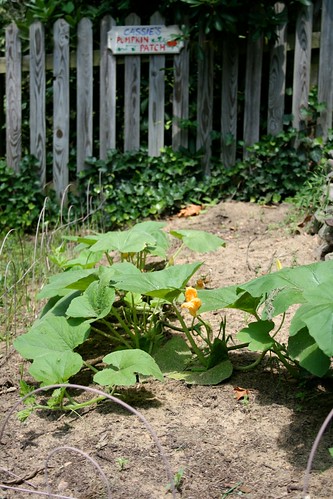
Pumpkin patch

So the plan for this coming growing season is to take a whole section of backyard, build four raised beds, and have a true kitchen garden. I want to see, if we plan well, how much of our own food we can produce. Of course, we still have those pesky HOA restrictions against chickens (grumble, grumble), so this experiment will be limited to fruits and vegetables.

Site
I've chosen the site of my kitchen garden with several things in mind. For one, proximity to the kitchen! I can step out the back door of the kitchen, cross the deck, and pick some green beans. Also, in our largely shady yard, this spot is one that gets a bit more sun, as there is a small gap in the canopy of oaks. I can also keep an eye on it from the kitchen. And last but not least, it doesn't interfere with the more decorative landscaping in other areas of the yard.

Soil
One of the biggest investments we will make in our new garden is to fill the raised beds with good soil. To enrich the soil and keep it well-fed throughout the growing season, we hope to make use of our own compost for the first time this year. First, we have a traditional compost bin that has been happily working away at our leaves and kitchen scraps for several months now. We made it out of a big plastic bin, and have been very happy with how unobtrusive it's been. Easy!

But the compost I am most excited about will come from my very first livestock! They may prevent me from keeping chickens, or goats, or a pig, but they cannot take away... my WORMS! That's right, folks, I am the proud owner of a Worm Factory, currently home to 500 red wriggler worms, who are already hard at work processing our kitchen scraps and old newspapers into nutrient-rich castings. By summer, we should have a good regular supply of compost, including worm tea to use as liquid fertilizer!

Seed
The dead of winter is the perfect time for browsing seed catalogs. (If you have a favorite, please do share in the comments, I am always looking for new sources.) Once again this year, I will be using 100% organic seeds. In the past, my seeds have come from Seed Savers Exchange and Seeds of Change, both of which I have been very happy with. Choosing exactly which variety, narrowing down the range of what we will grow (from "everything!" to just "what will fit in our garden"), dreaming of what it will all look like and taste like... ah, this is what winter is for. And since we start as much as possible from seed, there's no time to waste -- some things actually need to be started in February! Before we know it, the dining room table will once again be covered in trays of seedlings!

A few new books have been well-springs of inspiration as I plan this year. The Backyard Homestead is full of practical gardening advice, as well as tips on preserving and extending the harvest (and lots of fun daydreamy projects like building a chicken coop... someday!). Also, I am loving The Family Kitchen Garden, a book I picked up a few days ago and have hardly put down since. So much wisdom about gardening with children, including great practical advice on companion planting. This is very useful, since this year I fully intend to be a bit less whimsical in my garden planning. For instance, I will not plant a melon right next to my eggplant -- I spent the whole summer pulling melon tendrils off the poor innocent eggplant plant, muttering things like "keep your hands to yourself, sheesh!"

In June, when I'm outside trying to keep the weeds and bugs away from my precious veggies, I may question my sanity for ever having such grandiose dreams of backyard food production. But for now, snug in my warm house with the seed catalogs and the gardening books, it feels right to plan and to dream.